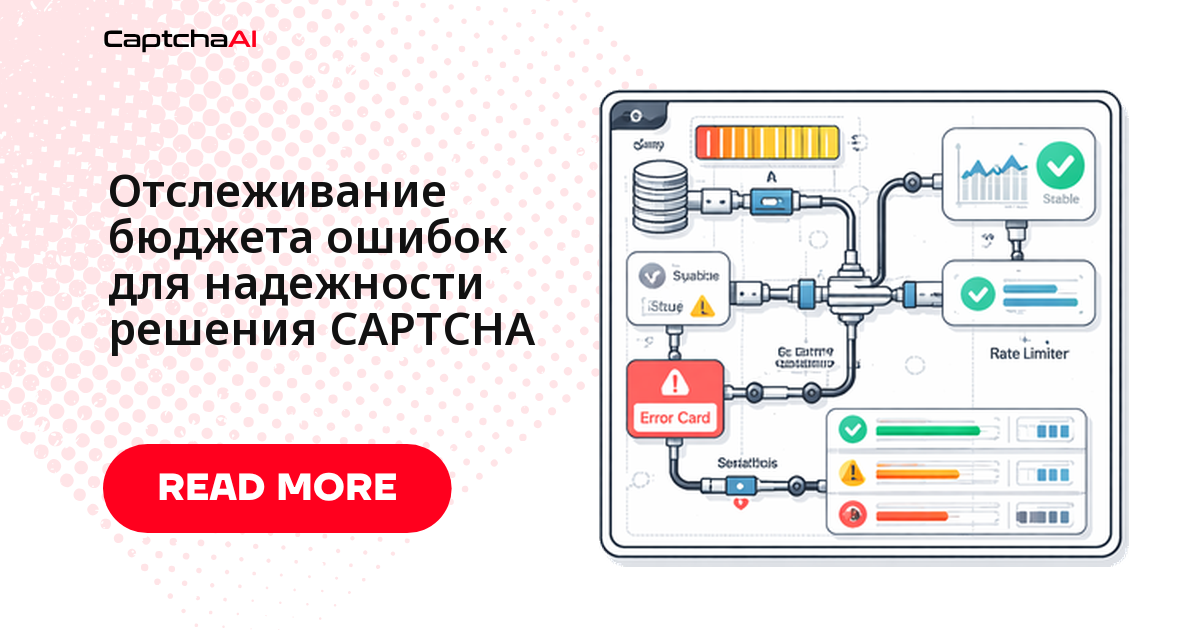
Алерт в 3:47 ночи: доля успешных решений reCAPTCHA v2 упала до 94,2 % при целевых 95 %. Будить команду? «Просело» ничего не говорит о серьёзности. Бюджет ошибок переводит SLO в число: сколько отказов допустимо и что делать, когда лимит исчерпан.
Зачем считать бюджет ошибок, а не просто следить за uptime
Мониторинг uptime отвечает «работает или нет». Бюджет ошибок отвечает на другой вопрос — «сколько ещё можно ошибаться, прежде чем нарушить SLO». Он превращает абстрактный SLO в конкретный операционный лимит для дежурной команды.
Разница особенно заметна в трёх ситуациях:
- Резкий, но короткий всплеск отказов — uptime-мониторинг может его не заметить, а burn rate покажет мгновенно.
- Медленная деградация одного типа CAPTCHA на фоне стабильного uptime всей остальной инфраструктуры.
- Решение, когда деплой можно продолжать, а когда релизы стоит остановить — бюджет даёт число, а не ощущение «вроде норм».
| Понятие | Что означает | Пример |
|---|---|---|
| SLO | Целевая доля успеха | 95 % успешных решений |
| Бюджет ошибок | Допустимая доля отказов | 5 % решений могут провалиться |
| Burn rate | Скорость расхода бюджета | 2× — бюджет исчезнет за полокна |
| Окно измерения | Период расчёта | скользящие 24 ч или 7 дней |
При SLO 95 % на окне 24 ч и 10 000 решениях бюджет — 500 неудач. При 500 отказах деплои стоит приостановить.
Локальный пример: команды с инстансами в Европе и нестабильными мобильными сетями
У команд, чьи воркеры развёрнуты в дата-центрах Frankfurt или Amsterdam — стандартный выбор для разработчиков из России, Беларуси, Казахстана и Украины, — есть дополнительный источник шума: сетевые таймауты на нестабильных мобильных сетях искажают долю успеха сильнее, чем реальные отказы решателя. Прежде чем снижать SLO, разделите отказы на два бакета — таймаут соединения и отказ решения, — иначе бюджет ошибок будет «сгорать» из-за проблем сети, а не из-за CAPTCHA.
Если вы логируете параметры запроса вместе с событием бюджета для отладки, собирайте только то, что вправе обрабатывать: session ID и sitekey достаточно для разбора инцидента, а персональные данные пользователя в лог бюджета ошибок попадать не должны — это касается и 152-ФЗ «О персональных данных» для читателей из РФ, и добросовестной проверки в духе GDPR для кросс-граничных команд.
Трекер бюджета ошибок на Python
Хранит события в окне, считает burn rate, вызывает колбэки при переходе HEALTHY → WARNING → CRITICAL → EXHAUSTED. Подставьте API-ключ, вызывайте record() после каждой попытки.
import time
import threading
from dataclasses import dataclass, field
from collections import deque
from enum import Enum

API_KEY = "YOUR_API_KEY"


class BudgetStatus(Enum):
    HEALTHY = "healthy"          # Budget > 50% remaining
    WARNING = "warning"          # Budget 10-50% remaining
    CRITICAL = "critical"        # Budget < 10% remaining
    EXHAUSTED = "exhausted"      # Budget depleted


@dataclass
class SLOConfig:
    """Service Level Objective configuration."""
    target_success_rate: float = 0.95  # 95%
    window_seconds: int = 86400        # 24 hours
    warning_threshold: float = 0.50    # Alert at 50% budget
    critical_threshold: float = 0.10   # Alert at 10% budget


@dataclass
class ErrorBudgetEvent:
    timestamp: float
    success: bool


class ErrorBudgetTracker:
    """Tracks error budget consumption for CAPTCHA solving."""

    def __init__(self, config: SLOConfig = SLOConfig()):
        self.config = config
        self._events: deque[ErrorBudgetEvent] = deque()
        self._lock = threading.Lock()
        self._callbacks: dict[BudgetStatus, list[callable]] = {
            status: [] for status in BudgetStatus
        }
        self._last_status = BudgetStatus.HEALTHY

    def on_status_change(self, status: BudgetStatus, callback: callable):
        """Register a callback for status transitions."""
        self._callbacks[status].append(callback)

    def record(self, success: bool):
        """Record a solve attempt."""
        now = time.monotonic()
        event = ErrorBudgetEvent(timestamp=now, success=success)

        with self._lock:
            self._events.append(event)
            self._prune(now)
            new_status = self._compute_status()

            if new_status != self._last_status:
                self._last_status = new_status
                for cb in self._callbacks.get(new_status, []):
                    try:
                        cb(self.get_report())
                    except Exception as e:
                        print(f"[BUDGET] Callback error: {e}")

    def _prune(self, now: float):
        """Remove events outside the window."""
        cutoff = now - self.config.window_seconds
        while self._events and self._events[0].timestamp < cutoff:
            self._events.popleft()

    def _compute_status(self) -> BudgetStatus:
        remaining = self.remaining_fraction
        if remaining <= 0:
            return BudgetStatus.EXHAUSTED
        if remaining < self.config.critical_threshold:
            return BudgetStatus.CRITICAL
        if remaining < self.config.warning_threshold:
            return BudgetStatus.WARNING
        return BudgetStatus.HEALTHY

    @property
    def total_events(self) -> int:
        with self._lock:
            return len(self._events)

    @property
    def success_count(self) -> int:
        with self._lock:
            return sum(1 for e in self._events if e.success)

    @property
    def failure_count(self) -> int:
        with self._lock:
            return sum(1 for e in self._events if not e.success)

    @property
    def current_success_rate(self) -> float:
        total = self.total_events
        return self.success_count / total if total > 0 else 1.0

    @property
    def error_budget_total(self) -> float:
        """Total allowed failures in the window."""
        total = self.total_events
        if total == 0:
            return 0
        return total * (1 - self.config.target_success_rate)

    @property
    def error_budget_remaining(self) -> float:
        """Remaining failure allowance."""
        return max(0, self.error_budget_total - self.failure_count)

    @property
    def remaining_fraction(self) -> float:
        """Fraction of error budget remaining (0.0 to 1.0)."""
        budget = self.error_budget_total
        if budget <= 0:
            return 1.0 if self.failure_count == 0 else 0.0
        return max(0, self.error_budget_remaining / budget)

    @property
    def burn_rate(self) -> float:
        """How fast the budget is being consumed (1.0 = normal, 2.0 = 2× faster)."""
        total = self.total_events
        if total == 0:
            return 0.0
        expected_failures = total * (1 - self.config.target_success_rate)
        if expected_failures == 0:
            return 0.0
        return self.failure_count / expected_failures

    def get_report(self) -> dict:
        return {
            "status": self._last_status.value,
            "slo_target": self.config.target_success_rate,
            "current_rate": round(self.current_success_rate, 4),
            "total_events": self.total_events,
            "successes": self.success_count,
            "failures": self.failure_count,
            "budget_total": round(self.error_budget_total, 1),
            "budget_remaining": round(self.error_budget_remaining, 1),
            "budget_remaining_pct": round(self.remaining_fraction * 100, 1),
            "burn_rate": round(self.burn_rate, 2),
        }


# --- Integration with solver ---

budget = ErrorBudgetTracker(SLOConfig(
    target_success_rate=0.95,
    window_seconds=3600,  # 1-hour window for demo
))

# Register alerts
budget.on_status_change(BudgetStatus.WARNING, lambda r:
    print(f"[ALERT] Budget warning: {r['budget_remaining_pct']}% remaining"))

budget.on_status_change(BudgetStatus.CRITICAL, lambda r:
    print(f"[ALERT] Budget critical: {r['budget_remaining_pct']}% remaining"))

budget.on_status_change(BudgetStatus.EXHAUSTED, lambda r:
    print(f"[ALERT] Budget EXHAUSTED — throttle new requests"))


def solve_with_budget(params: dict) -> str:
    """Solve CAPTCHA while tracking error budget."""
    import requests

    if budget._last_status == BudgetStatus.EXHAUSTED:
        raise RuntimeError("Error budget exhausted — solving paused")

    try:
        submit_params = {**params, "key": API_KEY, "json": 1}
        resp = requests.post(
            "https://ocr.captchaai.com/in.php", data=submit_params, timeout=30
        ).json()
        if resp.get("status") != 1:
            budget.record(False)
            raise RuntimeError(f"Submit: {resp.get('request')}")

        task_id = resp["request"]
        start = time.monotonic()
        while time.monotonic() - start < 180:
            time.sleep(5)
            poll = requests.get("https://ocr.captchaai.com/res.php", params={
                "key": API_KEY, "action": "get", "id": task_id, "json": 1,
            }, timeout=15).json()

            if poll.get("request") == "CAPCHA_NOT_READY":
                continue
            if poll.get("status") == 1:
                budget.record(True)
                return poll["request"]

            budget.record(False)
            raise RuntimeError(f"Solve: {poll.get('request')}")

        budget.record(False)
        raise RuntimeError("Timeout")

    except Exception:
        budget.record(False)
        raise


# Usage
for i in range(100):
    try:
        token = solve_with_budget({
            "method": "turnstile",
            "sitekey": "0x4XXXXXXXXXXXXXXXXX",
            "pageurl": "https://example.com",
        })
    except RuntimeError as e:
        if "exhausted" in str(e):
            print(f"Stopped at iteration {i}")
            break

print(budget.get_report())
Трекер бюджета ошибок на JavaScript
Та же логика на JavaScript — приватные поля класса, колбэки через on(). Подходит для Node.js-воркеров, опрашивающих res.php напрямую.
class ErrorBudgetTracker {
  #events = [];
  #config;
  #callbacks = {};

  constructor(config = {}) {
    this.#config = {
      targetRate: config.targetRate || 0.95,
      windowMs: config.windowMs || 3600_000,
      warningThreshold: config.warningThreshold || 0.5,
      criticalThreshold: config.criticalThreshold || 0.1,
    };
    this.lastStatus = "healthy";
  }

  on(status, callback) {
    this.#callbacks[status] = this.#callbacks[status] || [];
    this.#callbacks[status].push(callback);
  }

  record(success) {
    const now = Date.now();
    this.#events.push({ time: now, success });
    this.#prune(now);

    const newStatus = this.#computeStatus();
    if (newStatus !== this.lastStatus) {
      this.lastStatus = newStatus;
      for (const cb of this.#callbacks[newStatus] || []) {
        cb(this.report());
      }
    }
  }

  #prune(now) {
    const cutoff = now - this.#config.windowMs;
    while (this.#events.length && this.#events[0].time < cutoff) {
      this.#events.shift();
    }
  }

  #computeStatus() {
    const frac = this.remainingFraction;
    if (frac <= 0) return "exhausted";
    if (frac < this.#config.criticalThreshold) return "critical";
    if (frac < this.#config.warningThreshold) return "warning";
    return "healthy";
  }

  get total() { return this.#events.length; }
  get successes() { return this.#events.filter((e) => e.success).length; }
  get failures() { return this.#events.filter((e) => !e.success).length; }
  get currentRate() { return this.total ? this.successes / this.total : 1; }

  get budgetTotal() {
    return this.total * (1 - this.#config.targetRate);
  }

  get budgetRemaining() {
    return Math.max(0, this.budgetTotal - this.failures);
  }

  get remainingFraction() {
    const bt = this.budgetTotal;
    if (bt <= 0) return this.failures === 0 ? 1 : 0;
    return Math.max(0, this.budgetRemaining / bt);
  }

  get burnRate() {
    const expected = this.total * (1 - this.#config.targetRate);
    return expected > 0 ? this.failures / expected : 0;
  }

  report() {
    return {
      status: this.lastStatus,
      currentRate: Math.round(this.currentRate * 10000) / 10000,
      total: this.total,
      failures: this.failures,
      budgetRemainingPct: Math.round(this.remainingFraction * 1000) / 10,
      burnRate: Math.round(this.burnRate * 100) / 100,
    };
  }
}

// Usage
const budget = new ErrorBudgetTracker({ targetRate: 0.95, windowMs: 3600_000 });

budget.on("warning", (r) => console.log(`[WARN] ${r.budgetRemainingPct}% budget left`));
budget.on("exhausted", (r) => console.log("[ALERT] Budget exhausted!"));

// Record results from your solver
budget.record(true);   // success
budget.record(false);  // failure
console.log(budget.report());
Алерты по скорости сгорания бюджета
Сам процент бюджета мало говорит о срочности — важнее скорость, с которой он тает. Burn rate 1,0 — идёте по графику; 2,0 — хватит на половину окна, реагировать нужно заранее.
| Скорость сгорания | Что значит | Что делать |
|---|---|---|
| < 1,0 | Медленнее плана | Не требуется |
| 1,0 | Впритык до конца окна | Наблюдать внимательнее |
| 2,0 | Закончится за половину окна | Разобраться и притормозить изменения |
| 5,0+ | Тает почти мгновенно | Приостановить некритичные решения |
Частые проблемы и их решения
- Бюджет сгорает слишком быстро. Причина — SLO задан жёстче, чем позволяют текущие условия. Пересчитайте SLO по историческим данным за 2–4 недели.
- Бюджет почти не расходуется. Причина — SLO слишком мягкий и не отражает реальные риски. Ужесточите SLO, чтобы бюджет стал полезным сигналом.
- Статус скачет между HEALTHY и WARNING. Причина — слишком короткое окно измерения. Увеличьте окно (24 ч вместо 1 ч).
- Burn rate вводит в заблуждение. Причина — мало событий в выборке. Считайте burn rate только после минимального числа событий.
- Трекер «съедает» память. Причина — старые события не удаляются. Проверьте, что
_pruneвызывается в каждомrecord().
Вопросы, которые чаще всего задают про бюджет ошибок
Как выбрать окно измерения — скользящее или календарные сутки?
Скользящее удобнее: календарные сутки создают «обнуление в полночь», и ночная серия отказов теряется в отчёте следующего дня. 24 часа — разумный старт, для медленных SLO — окно в 7 дней.
Нужно ли вести отдельный бюджет для каждого типа CAPTCHA?
Да. reCAPTCHA v2, Turnstile и image-CAPTCHA ведут себя по-разному, общий бюджет маскирует деградацию конкретного типа. Задайте SLO под тип — например, 93 % для reCAPTCHA v2 и 97 % для Turnstile.
Как связать бюджет ошибок с ротацией дежурных (on-call)?
Подключите пороги WARNING и CRITICAL к каналу с остальными SLO-алертами — дежурный должен видеть бюджет CAPTCHA рядом с другими сервисами. EXHAUSTED эскалируйте сразу.
Что делать, если burn rate ночью резко подскочил выше 5,0?
Не ждите утра: остановите неприоритетные решения (тестовые прогоны, фоновые задачи) и на время переключитесь на ручную проверку CAPTCHA для критичных сценариев, пока причина всплеска не найдена. Утром разберитесь, был ли это сбой сети, изменение защиты на стороне сайта или проблема на вашей стороне.
Что дальше
Свяжите бюджет ошибок с остальной инфраструктурой решения CAPTCHA: